|
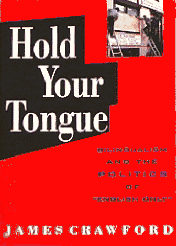
Hold Your Tongue
Preface
By James Crawford
There is nothing new about ethnic intolerance. But in the
United States of the 1980s, it assumed a guise we had not seen before:
the politics of English Only.
Traditionally taken for granted, our national tongue emerged
as a cause célèbre, a civic passion touching
nearly every state house, the U.S. Congress, and numerous municipalities.
The fervor was not so much for English as against the growing
prominence of other languages. "Bilingualism" had arrived, to the dismay
of many monolingual Americans. Some claimed it was now easier to function
in English when traveling abroad than in the immigrant ghettos of U.S.
cities. Apparently today's newcomers, unlike their predecessors, felt no
obligation to learn our language. Did they expect us to learn Spanish?
shocked Anglo-Americans wanted to know. Whose country was this, after all?
Most amazing, government was pursuing policies that seemed to discourage
English acquisition: bilingual schooling, bilingual driver's tests, bilingual
welfare forms, even bilingual assistance in the voting booth. Could we
afford to accommodate millions of new Americans – literally scores of different
language groups – each in their own tongue? Would Congress soon be translating
its proceedings, United Nations-style, with members listening through a
headset? Where would it end?
Such anxieties and resentments have given rise to a movement
to declare English the nation's official language. While the objective
may seem innocuous, the proposed means are not. A constitutional English
Language Amendment seeks to prohibit most uses of other tongues by government
(federal, state, and local) and, in some circumstances, by individuals.
Whether it would achieve these aims no one can say with certainty. But,
if adopted, the measure would jeopardize a wide range of rights and services
now available to non-English speakers, from bilingual clerks at city hall
to freedom of speech itself. At a symbolic level, Official English would
be a way of telling newcomers, "Conform or get out." Indeed, that message
has already been conveyed by the current agitation, polarizing several
communities where Hispanics or Asians have settled.
Americans are not accustomed to quarreling over language.
Earlier generations of nativists were usually too preoccupied with immigrants'
race or religion to worry whether their English skills were up to snuff.
Contrary to melting pot mythology, newcomers often maintained their native
tongues for generations on U.S. soil. Many fought for and, depending on
their political clout, won concessions like bilingual public education,
which was commonplace in nineteenth century "German America." Moreover,
this country has a kind of libertarian tradition where language is concerned
– a democracy is not supposed to tell its citizens how to talk – which
may explain the Founders' "oversight" when it came to mandating an official
tongue.
This is not to say the tradition has been consistent.
At various points in our history, linguistic minorities have faced policies
of exclusion or coercive assimilation or both. Yet, unlike today's campaigns,
these were normally aimed at particular groups for particular purposes
– for example, in the 1880s, when federal authorities decided that "the
first step ... toward teaching the Indians the mischief and folly of continuing
in their barbarous practices" was to force their children to attend English-only
boarding schools; or in 1897, when Pennsylvania enacted an English-proficiency
requirement for miners, seeking to bar Italians and Slavs from the coal
fields; or in 1921, when Republicans in New York pushed through an English
literacy test for voting, hoping to disfranchise one million Yiddish speakers
who had an annoying habit of electing Democrats.
What distinguishes today's English Only phenomenon is
the apocalyptic nature of its fears: that the American language is "threatened"
and, with it, the basis of American nationhood. We are warned that unless
action is taken to halt our "mindless drift toward a bilingual society,"
the United States will soon be balkanized, divided, at war with itself.
Ostensibly to defend "the primacy of English," a new cadre of zealots is
working to restrict speech in other tongues. And there is a real chance
that such proposals could become law; in several states, they already have.
Worries about the slipping status of English in the United
States come, ironically, at a time when English continues to spread as
a world language, the undisputed medium of international business, science,
and statecraft. To be sure, this country is more diverse, linguistically
and otherwise, than a generation ago. Immigration is the major reason.
Exotic cultural enclaves have appeared not only in coastal cities, but
throughout the heartland. In 1960, how many residents of Fort Smith, Arkansas,
or Garden City, Kansas, would have foreseen a Vietnamese community in their
midst? (How many had even heard of Vietnam?) Just as in the past, the newcomers
find it natural to preserve remnants of their homeland – food, customs,
religion, and language – that some Americans find jarring. The number of
U.S. residents who speak a minority tongue at home increased by 41 percent
during the 1980s. Yet at the same time, all available evidence shows that
today's immigrants are learning English faster than ever
before. By objective measures, bilingualism is no more prevalent now than
in several earlier periods of U.S. history.
So what accounts for the new English Only mentality? Some
say bigotry. It is no coincidence that the targets of antibilingual campaigns
are frequently racial as well as linguistic minorities. Leaders of U.S.
English, the major lobby promoting an English Language Amendment, have
expressed an animus toward Hispanics in particular. This organization is
an outgrowth of the immigration restriction movement. One of its founders
has warned that Spanish speakers may use their "greater reproductive powers"
to seize political control in the United States. ("Perhaps this is the
first instance in which those with their pants up are going to get caught
by those with their pants down!") A similar group, English First, complains:
"Tragically, many immigrants these days refuse to learn English! They never
become productive members of American society. They remain stuck in a linguistic
and economic ghetto, many living off welfare and costing working Americans
millions of tax dollars each year." It goes on to claim that "radical activists
have been caught sneaking illegal aliens to the polls on election day and
using bilingual ballots to cast fraudulent votes." The fact that U.S. English
and English First have raised millions of dollars with such appeals suggests
a sizable nativist constituency.
Nevertheless, it is a mistake to assume that enthusiasm
for Official English is driven solely, or even primarily, by such prejudices.
According to opinion polls and election results, about three Americans
in four are inclined to endorse the idea. Many ask: Shouldn't newcomers
be expected to learn English, for their own good and the country's? What's
racist about that? Nothing whatsoever. Bilingual accommodations are the
issue. Should government be able to provide them, as needed, to ease immigrants'
transition into this society? Should there be an affirmative right
to certain services in minority tongues? Or should public-sector bilingualism
be banned by law? When Congress passed the Bilingual Education Act of 1968
and the bilingual voting rights amendments of 1975, it galloped headlong
into this arena with little foresight and almost no public discussion.
Such an abrupt turn in policy was bound to provoke debate sooner or later.
At last, language issues are beginning to receive some needed attention.
It is only unfortunate that vital programs, for example, the schooling
of limited-English-proficient children, are now held hostage to symbolic
politics.
English Only flows from insecurity. Now that demographic
changes of all kinds – greater mobility, nontraditional families, mass
culture – are disrupting Americans' sense of community, there is a renewed
search for unifying institutions. With ethnic warfare spreading in eastern
Europe, many are wondering when it will reach our shores. Already, there
is talk of "tribalism" and "the disuniting of America" from those who fear
that common ties are being frayed by group claims of all descriptions.
Many fair-minded people, who otherwise cherish individual rights and cultural
pluralism, are beginning to wonder whether the national tongue may be an
exceptional case. Perhaps "unilingualism" is our best hope of managing
diversity. If so, they feel, it becomes too precious to risk and legislating
conformity becomes justifiable.
It is the aim of this book to show how mistaken, how shortsighted,
and how disastrous that view can be.
COPYRIGHT NOTICE: Copyright © 1992
by James Crawford. All rights reserved. Feel free to print or download
this excerpt for personal use. But republication of this material in any
form and for any purpose – including course use and Internet postings –
is prohibited, except by permission of the author, at this email address. Before writing, please read my permissions FAQ.

|